Showing posts with label Early Reviewers. Show all posts

Wednesday, January 15, 2014

2014-1 The Wilde Passions of Dorian Gray

Author: Mitzi Szereto
Title: The Wilde Passions of Dorian Gray, a Novel
Themes: immortality, youth, searching for new physical experiences, violence, rape, sex, debasement

Plot: From Amazon "Inspired by Oscar Wilde’s classic novel The Picture of Dorian Gray, Mitzi Szereto’s Wilde Passions of Dorian Gray continues where Wilde left off with the Faustian tale of a man of eternal youth and great physical beauty who lives a life of corruption, decadence and hedonism. The story begins in the bordellos of Jazz-Age Paris, moving to the opium dens of Marrakesh and the alluring anonymity of South America. In his pursuit of sensation and carnal thrills, Dorian’s desires turn increasingly extreme and he leaves behind yet more devastation and death. He ultimately settles in present-day New Orleans, joining with a group of like-minded beings known as The Night People. They inadvertently return to Dorian his humanity when he falls in love with a young woman he rescues from becoming their victim. She will be his redemption, but she will also be his final curse."

My Thoughts: Szereto's The Wild Passions of Dorian Gray was a surprising "sequel" to Oscar Wilde's classic. I was not expecting erotica. I was certainly not expecting such violent erotica. Of course I can see where the author was coming  from with this idea, and I can see how it could be a logical continuation of Dorian Gray's story. I'm not sure it made for a great story, and the violence made me extremely uncomfortable through the entire book.

I appreciated the different locations Dorian has to run to to escape anyone noticing his eternal youth (Paris, Marrakesh, Brazil, etc.) and how quickly the decades seem to pass for him.

I did find the ending rather abrupt and less than convincing. It seemed a rather forced end, as though the author simply did not know how to wrap up Dorian Gray's escapades.

Rating: 1/2 star....


Saturday, November 23, 2013

The Wet and the Dry by Lawrence Osborne

Title: The Wet and the Dry: A Drinker's Journey
Author: Lawrence Osborne
Themes: travel, alcoholism
Rating: **1/2

Plot: From Amazon.com "Drinking alcohol: a beloved tradition, a dangerous addiction, even “a sickness of the soul” (as once described by a group of young Muslim men in Bali). In his wide-ranging travels, Lawrence Osborne—a veritable connoisseur himself—has witnessed opposing views of alcohol across cultures worldwide, compelling him to wonder: is drinking alcohol a sign of civilization and sanity, or the very reverse? Where do societies and their treatment of alcohol fall on the spectrum between indulgence and restraint?

These questions launch the author on an audacious journey, from the Middle East, where drinking is prohibited, to the West, w

An immersing, controversial, and often irreverent travel narrative, The Wet and the Dry offers provocative, sometimes unsettling insights into the deeply embedded conflicts between East and West, and the surprising influence of drinking on the contemporary world today."
here it is an important—yet perhaps very often a ruinous—part of everyday life. Beginning in the bar of a luxury hotel in Milan, Osborne then ventures to the Hezbollah-threatened vineyards of Lebanon; a landmark pub in London; the dangerous drinking dens on the Malaysian border; the only brewery in the alcohol-hostile country of Pakistan; and Oman, where he faces the absurd challenge of finding a bottle of champagne on New Year’s Eve.  Amid his travels, Osborne unravels the stories of alcoholism in his own family, and reflects on ramifications of alcohol consumption in his own life.

My Thoughts: Osborne's short memoir on Drinking, predominately in the Middle East and North Africa, is rather rambling but full of interesting historical and societal facts. I enjoyed the sporadic inclusions of alcohol-in-history that Osborne peppers through his travels through the Middle East-searching for illegal alcohol.

Osborne relates his own alcoholism, although the reader is never quite sure how he truly feels about it. Even as he describes the deaths of loved ones who abused alcohol, he never quite connects it to his own alcoholism. He admits that Islamic countries have valid reasons for creating "dry" states, but cannot quite escape the lure of drunkenness...for even a single day apparently. As another reviewer says, it is very morally ambiguous. He seems to worship alcohol, and this is some feeble attempt to praise it's benefits against Islamic practices.

While I found this meandering memoir rather entertaining most of the time, and the "non-fiction/historical" facts absolutely fascinating; I must admit I found the "memoir"-ish parts rather boring and sometimes downright condescending (pg. 32 comes to mind). I think Osborne would make a wonderful writer of social/historical texts, but in this tome I found him self-indulgent, condescending, and plain unpleasant. I have no qualms with alcohol, but the way he glorifies the drunken state rubbed me the wrong way.

Osborne, Lawrence. The Wet and the Dry: A Drinker's Journey. New York: Crown, 2013.

Wednesday, November 20, 2013

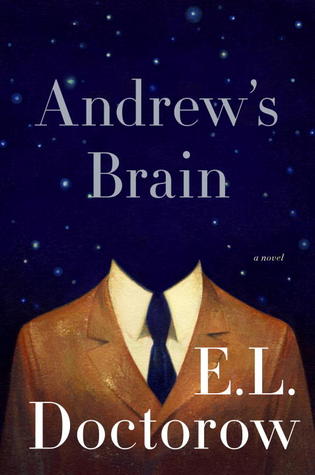
Andrew's Brain by E. L. Doctorow

Title: Andrew's Brain
Author: E. L. Doctorow
Themes: memory, relative reality, stream of consciousness, love, responsibility, sanity
Rating: ***

Plot: From Amazon.com "This brilliant new novel by an American master, the author of Ragtime, The Book of Daniel, Billy Bathgate, and The March, takes us on a radical trip into the mind of a man who, more than once in his life, has been the inadvertent agent of disaster.

Speaking from an unknown place and to an unknown interlocutor, Andrew is thinking, Andrew is talking, Andrew is telling the story of his life, his loves, and the tragedies that have led him to this place and point in time. And as he confesses, peeling back the layers of his strange story, we are led to question what we know about truth and memory, brain and mind, personality and fate, about one another and ourselves. Written with psychological depth and great lyrical precision, this suspenseful and groundbreaking novel delivers a voice for our times—funny, probing, skeptical, mischievous, profound."

My Thoughts: Doctorow gives us a bit of a puzzling tale in Andrew's Brain. This is essentially a monologue between Andrew (who sometimes refers to himself in third person) and what the reader eventually assumes is a mandated therapist. How and why Andrew ended up in this conversation is never explicitly stated...in fact very little is explicitly stated, or linearly stated. This is a rambling story from a troubled man who provides his stream of consciousness. Andrew "The Pretender" seems to bring disaster with him, which provides some interesting anecdotes but leaves the reader wondering what the novel was all about come the concluding paragraph.

Similar Reads: White Noise by Don Delillo, Catcher in the Rye by J. D. Salinger

Doctorow, E. L. Andrew's Brain. New York: Random House, 2014.

Saturday, June 8, 2013

The Forgiven by Lawrence Osborne

Title: The Forgiven
Author: Lawrence Osborne
Themes: responsibility, forgiveness, colonization, "the Other"
Rating: ***

Plot: (from Amazon.com) In this haunting novel, journalist and novelist Lawrence Osborne explores the reverberations of a random accident on the lives of Moroccan Muslims and Western visitors who converge on a luxurious desert villa for a decadent weekend-long party.     
     David and Jo Henniger, a doctor and a children's book author, in search of an escape from their less than happy lives in London, accept an invitation to attend a bacchanal at their old friends' home, deep in the Moroccan desert. But as a groggy David navigates the dark desert roads, two young men spring from the roadside, the car swerves...and one boy is left dead.
     When David and Jo arrive at the party, the Moroccan staff, already disgusted by the rich, hedonistic foreigners in their midst, soon learn of David's unforgivable act. Then the boy's irate Berber father appears, and events begin to spin beyond anyone's control.
     With spare, evocative prose, searing eroticism, and a gift for the unexpected, Osborne memorably portrays the privileged guests wrestling with their secrets amid the remoteness and beauty of the desert landscape. He gradually reveals the jolting backstory of the young man who was killed and leaves David’s fate in the balance as the novel builds to a shattering conclusion.

My Thoughts: I admit that I was thinking entirely of L'etranger by Camus when I first picked up this novel. Both address issues of colonization, relationships between the West/Middle East-Africa, murder, and obviously 'the Other.' Unfortunately the characters aren't entirely "fleshed out," and it can sometimes seem as though Osborne is writing about "poor, desperate post-colonial Moroccans" versus "decadent, imperialist Westerners" in a very cliched way. I think this is partly his writing style because the plot really does have a rather epic (morbid, depressing, hopeless) feel; the oppressive desert seems to have a life of its own as constant backdrop to the ridiculously decadent party David is headed to as well as the abject poverty the Moroccans face. However, occasionally Osborne moves away from the archetypes Camus utilized and creates individuals...admittedly not individuals that are very sympathetic, likeable, or "good" but individuals nonetheless. This keeps the novel from venturing too far into cliche or allegory, by making humans out of his characters Osborne has definitely created a more thought provoking story about Western/"Other" relations.

I'm still not sure what to think of The Forgiven, which is good because it forces thought! But it makes for a difficult review. I found the big bash thrown by Richard and Dally to be over-the-top ridiculous, the ease of bribing Moroccan police horrifying, and the ending rather abrupt after such a meandering story (it felt so languid and slow despite all the exciting events unfolding!).

Similar Reads: The Stranger by Albert Camus

Osborne, Lawrence. The Forgiven. London: Hogarth, 2012.

Monday, August 1, 2011

The Foreigners

Title: The Foreigners
Author: Maxine Swann
Themes: travel, escape, divorce, sexuality, manipulation, cruelty, ambition, independence
Rating: **1/2

Plot: Buenos Aires is a city of Parisian affections and national anxiety, of amorous young lovers, seedy ports, flooded slums, and a dazzling social elite. Into this heady maze of contradiction and possibility enter two women: Daisy, an American divorcée; and Isolde, a beautiful, lonely Austrian. In Buenos Aires, Isolde finds that her blond European looks afford her entrée to the kind of elite, alluring social world she never would have had access to in her home country, but her ascension also sets her up for a long, surprising fall. Meanwhile, Daisy joins forces with Leonarda, a chameleonic Argentine with radical dreams of rebellion, who transfixes Daisy with her wild effervescence. Soon, Daisy is throwing off her American earnestness and engaging in a degree of passion, manipulation, and risk-taking in a way she never has before. Buenos Aires has allowed her to become someone else.

Against the throbbing backdrop of this shimmering and decadent city- almost a character in itself-Maxine Swann has created a stunning narrative of reawakened sensuality and compulsive desire that simultaneously explores with remarkable acuity themes of foreignness, displacement, and the trembling metamorphoses that arise from such states. From the award-winning, critically celebrated author of Flower Children, The Foreigners is a startlingly bold and original, unforgettable next novel.

My Thoughts: Like Swann's previous novel, The Foreigners is sultry and exotic for it's strangeness in a familiar context. For some reason I classify them both as "summer" stories. They both seem to resonate oppressive summer heat and humidity, and the lethargy of a hot summer day...it's illogical but I thought I would share.

In The Foreigners a recently divorced American woman (Daisy) is fortunate enough to live freely in Beunos Aires in exchange for a study of waterworks. The novel revolves around a colorful cast of both natives and fellow ex-pats. She walks along touristy and homey streets, she flits through parties and her run down apartment, but the protagonist seems to delve deeper and deeper into some inexplicable madness after befriending Leonarda-who manipulates and torments others.

In an attempt to broaden her horizons and embrace life as she couldn't back home, Daisy instead seems to spiral out of control and instead begins mimicking the cruel and unreasonable acts of Leonarda. Swann tiptoes into the absurd as the novel progresses. By the end of the book The Foreigners feels more like a surrealist dream sequence than a travel story-and one closes the book with a vague sense of repulsion.

While not all of the characters or sub-plots were equally fleshed out or connected, The Foreigners was an absorbing and entertaining book. Overall, this was an interesting study in depravity and the absurd but I much preferred the more realistic and heart-felt characters and plots from Swann's previous novel Flower Children.

Recommendation: If you are a fan of travel narratives, especially located in Latin America, this fictional account of a divorcee's experience in Buenos Aires may be right up your alley. I found this novel lacked any sort of (positive) character growth or conclusions (at least believable ones), so if you prefer those elements you may wish to avoid The Foreigners. I was entertained and challenged by this short novel, and so recommend it with some hesitation.

Similar Reads: Flower Children by Maxine Swann, The Lover by Marguerite Duras

Swann, Maxine. The Foreigners. New York: Riverhead Books, 2011.

Friday, April 29, 2011

Carrots'n'Cake

Title: Carrots'N'Cake: Healthy Living One Carrot and Cupcake at a Time
Author: Tina Haupert
Themes: healthy living, diet, weight loss, exercise, personal experiences, nutrition, physical fitness, lifestyle
Rating: ***

Plot: From one of the most popular blogs comes an innovative, even fun way to diet. Carrots'N'Cake is all about eating your carrots...and savoring your cupcake, too. Tina Haupert shows how to drop the pounds and keep them off by adopting eating habits that are healthy, balanced, and above all, livable. She serves up easy-to-follow fitness routines, food tips, and her most popular feature: cookie Friday.

My Thoughts: I don't know if I would have picked this book up if not for Early Reviewers over at LibraryThing. I just usually don't "do" lifestyle books...but I am pretty happy that I got a chance to read and review this little tome. Haupert uses personal anecdotes as the binding theme to this fitness and nutrition manifesto. Her experiences as an adult woman who was suddenly inactive (for the first time since age three), working a desk job, and eating without a care to nutrition or weight lead naturally into her dedication to completely altering and improving her eating and exercising habits. I enjoyed her personal experiences and felt they tied together all of the tips Haupert offers-and appreciated the range of stories that included eating junk food at an office job to obsessing over a pug to the point of moving...twice...in order to have one. However, I just felt that I personally found it hard to connect to Haupert since my "health or fitness background" is the opposite...I've never been active and have always had to watch what I eat and am only now trying to improve both my exercise and eating habits.

Haupert's overlaying theme is moderation and a focus on healthy foods and prioritizing fitness. She argues that your visits to the gym should be what you center other activities around, not what is haphazardly fit into your schedule. She argues that your health should come first, not that it is easy, but that exercise and nutritious eating is essential and improves the quality of our lives. Haupert gives tips for "realistic dieting" that includes a discussion on moderation in how you eat, yes eat healthy food-but its good to have controlled splurges (like her cookie Friday) to keep up your motivation for eating healthy! I really like this concept and agree with it. With eating it is impossible (for me at least) to go all or nothing, I can't completely cut out chocolate and french fries! But it's doable to cut down on it, which still makes an improvement in your health.

Littered throughout the thematic chapters are recipes, from potato salad to oatmeal to carrot cake, Haupert offers recipes for healthy foods that are all fairly easy to look up. In this regard I am not fully prepared to review Carrots'N'Cake as I have only tried two of the recipes so far-Banana Oatmeal Chip Cookies, and Baked Banana Oatmeal (I love oatmeal and banana, obviously). But both of these were healthy, tasty, and easy to whip up so I am looking forward to trying a few more of the recipes included in the book.

With all of that said, I was also expecting a bit more from this book. It is largely stories of Haupert's life...with rather vague and sometimes obvious tips for better health (not that they aren't appreciated and motivational). When I cracked open this book I had expected a little more exercise and meal-planning based content. In this end, this is largely a series of vignettes from Haupert's life with a few recipes, tips, and exercise plans thrown in-in other words, a bit of fluff. That didn't stop my enjoyment of it, but I wouldn't go to this book looking for specific guidelines in changing your eating or exercising habits-it's more motivational than anything else.

Recommendation: I enjoyed reading Haupert's stories, trying her recipes, and motivating myself to make improvements in my exercise and eating habits. I would recommend this to anyone struggling with weight issues as a realistic and healthy way to "diet"-though I don't really consider Carrots'N'Cake a diet book...it is more of a fitness manifesto and memior.

Similar Reads: Runner's World Runner's Diet by Madelyn H. Fernstrom and Ted Spiker

Haupert, Tina. Carrots'N'Cake: Healthy Living One Carrot and Cupcake at a Time. New York: Sterling Epicure, 2011.

Sunday, April 3, 2011

A Tiger in the Kitchen

Title: A Tiger in the Kitchen: A Memoir of Food and Family
Author: Cheryl Lu-Lien Tan
Themes: food, cooking, family, heritage, culture
Rating: *** 1/2

Plot: Born in the year of the Tiger (a rebellious sign), Cheryl Lu-Lien Tan left Singapore at age 18 to attend Northwestern University. More than a decade later, as a 30-something living in New York City, she was suddenly gripped with a sense of loss at the knowledge that she was, indeed, "Ang Moh" (a Chinese term that implies "Westernized"). Tan did not know how to make the food of her people, and as any Singaporean will tell you, they don't eat to live-they live to eat. In the tiny Southeast Asian country that straddles the equator, food is both a national obsession and their way of bonding. As a way to pass the time while in the kitchen, they tell stories.

Now, Cheryl Tan invites readers to join her on a quest to recreate the dishes of her native Singapore as a way to connect food and family with her sense of home. As Tan begins cooking with her family, she learns not just about food, bit about her family history and her heritage. She finds that home is rooted in the kitchen and the foods of her Singaporean girlhood. A Tiger in the Kitchen is a charming story about being a Chinese-American and a food exile, and finding a place for one's heritage in a modern life.

My Thoughts: I was extremely excited to read this book for a few reasons, namely (1) it was a free Early Reviewer copy (I just love those uncorrected proofs), (2) it featured Singaporean food which I have never read about, and (3) I felt connected to the author because I also put off learning to cook until adulthood because I felt like I needed to be doing something less "housewifey" (which is just silly I know).

But I was also hesitant to dive right in because I feared (what I see as) an overemphasis on Singaporean/Non-Western culture versus the "vacuum" of American culture. I hate reading stories where becoming "Westernized" means losing culture, that only non-American/Western peoples have culture and that we (I am Western/American) are somehow lacking our own culture-happy just to suck it out of everyone else. I just feel like this approach cheapens everyone's sense of culture, and is a negative world-view in general. I am happy to report that Cheryl Lu-lien Tan handles her discussion of culture with nuance and grace-and I enjoyed every page of A Tiger in the Kitchen.

With that said, I feel I need to justify loving this book (I am a graduate student, I need to justify every claim after all). First of all, the writing is lovely. When Tan writes it feels both personal and professional-you feel like she is talking directly to you, but in a well planned and polished manner. The book flowed surprisingly well, with transitions and events leading into each other in entertaining ways. One would assume a book about learning to cook your family's food would be fairly tedious, but Tan brings together multiple food experiences from New York, Hawaii, China, and Singapore into a cohesive narrative that describes her reconnection to her family and country of origin. Yes it is a food memoir. But really the food is merely a tool to reconnect to family and address a difficult time in Tan's life, with every dish she loving describes and every cooking lesson she shares Tan is sharing her family's love and dedication-as well as its scandals and skeletons. If anything, it seems all the more intimate for its connection to food.

Keep in mind that this book will make you hungry. I have only read two other "food memoirs" but neither of them made me want to cook or eat as much as a single chapter of Tan's did. She describes dishes with such loving detail, I can just smell the pandan leaves and ginger and duck...and I appreciate the recipes at the back of the book just for this reason.

Recommendation: I highly recommend A Tiger in the Kitchen to anyone interested in Asia, food, or memoirs because of Tan's impressive writing, her thoughtful and amusing reflections on food and family, and the bittersweet connection she makes between family long gone through cooking.

Similar Reads: Blood, Bones, and Butter by Gabrielle Hamilton, Fannie's Last Supper by Chris Kimball

Tan, Cheryl Lu-Lien. A Tiger in the Kitchen: A Memoir of Food and Family. New York: Hyperion, 2011.

Monday, December 20, 2010

Blood, Bones, and Butter

Title: Blood, Bones, and Butter: The Inadvertent Education of a Reluctant Chef
Author: Gabrielle Hamilton
Themes: food, restaurants, growing up, family, drugs, marriage, Italy, New York, responsibility
Release: March 2011

Plot: Before Gabrielle Hamilton opened her acclaimed New York restaurant Prune, she spent twenty fierce, hard-living years trying to find purpose and meaning in her life. Above all she sought family, particularly the thrill and the magnificence of the one from her childhood that, in her adult years, eluded her. Hamilton’s ease and comfort in a kitchen were instilled in her at an early age when her parents hosted grand parties, often for more than one hundred friends and neighbors. The smells of spit-roasted lamb, apple wood smoke, and rosemary garlic marinade became as necessary to her as her own skin.

Blood, Bones & Butter follows an unconventional journey through the many kitchens Hamilton has inhabited through the years: the rural kitchen of her childhood, where her adored mother stood over the six-burner with an oily wooden spoon in hand; the kitchens of France, Greece, and Turkey, where she was often fed by complete strangers and learned the essence of hospitality; the soulless catering factories that helped pay the rent; Hamilton’s own kitchen at Prune, with its many unexpected challenges; and the kitchen of her Italian mother-in-law, who serves as the link between Hamilton’s idyllic past and her own future family—the result of a difficult and prickly marriage that nonetheless yields rich and lasting dividends.

Blood, Bones & Butter is an unflinching and lyrical work. Gabrielle Hamilton’s story is told with uncommon honesty, grit, humor, and passion. By turns epic and intimate, it marks the debut of a tremendous literary talent.

My Thoughts: Hamilton is a writer of great talent; with a steady voice and an unflinching view of her sometimes difficult life. If she wasn't more attuned to physical work (i.e. the restaurant), I think I would be reading some excellent fiction from her instead of this memoir. From the title I had assumed that this book would be about Hamilton's experiences learning to cook and opening a restaurant in New York City. I was pleasantly surprised to find so much more. This is a full biography (up-to-the-present) of a hard working and dedicated individual with a variety of life experiences, both terrible and sublime.

Hamilton's childhood and family are covered in the first third of the book, titled "Blood." Her rather whimsical and unusual family dynamic are explored, and honestly a whole book could be written on her experiences up until age twelve. The radical changing of this family dynamic sets the foundation for the rest of the book, where Hamilton struggles for independence and adulthood through restaurant work, cocaine, several college stints, and eventually an MFA and a restaurant of her own.

"Bones" seems to be presented as an in-between period of her life. In this second third of the book Hamilton has pulled her life together and is now on the straight-and-narrow, exploring writing and cooking both. Of the entire book, all of which is very exciting to read, this is the most dry-simply because the reader knows something more must be coming up, and so much titillating things have already happened.

In the third and final section of the memoir, "Butter" describes Hamilton's more recent experiences, including a difficult marriage and two children, in addition to the running of a restaurant and the strained family relationships she faces from her own family as well as her Italian in-laws. This final segment is the most poignant, and it seems to be very heart-felt, leaving Hamilton's emotions and pains out in the open for all to read.

I heartily enjoyed this memoir of a chef, because it wasn't just about cooking and the restaurant business. Hamilton writes about life experiences and all of those things that lead to food and inspire food. Her life as a chef wasn't a given, this memoir shows the twisted path that led her there and examines incidents along the way. Her writing style is casual yet well-crafted prose, and her willingness to expose so many faults, mistakes, and current problems are bound to engender respect, at the very least.

Recommendation: Anyone who likes memoirs, food, tales of family troubles and triumphs, will enjoy Hamilton's well-crafted memoir Blood, Bones, and Butter. Be forewarned, there is rampant cursing, in addition to drugs, theft, and melodrama.

Similar Reads: Fannie's Last Supper by Chris Kimball, Julie & Julia by Julie Powell*, Kitchen Confidential by Anthony Bourdain*, Heat by Bill Buford*, The Devil in the Kitchen by Marco Pierre White*

Hamilton, Gabrielle. Blood, Bones, and Butter:The Inadvertent Education of a Reluctant Chef. New York: Random House, 2011.

* I haven't read any of these, but similarities do seem to exist!

Wednesday, November 24, 2010

Book Review: Fannie's Last Supper

Title: Fannie's Last Supper: Two Years, Twelve Courses, and Creating One Amazing Meal from Fannie Farmer's 1896 Cookbook
Author: Chris Kimball
Themes: Food, Victoriana, Boston, Entertaining, Food History

Plot: In the mid-1990s, Chris Kimball moved into an 1859 Victorian townhouse on the South End of Boston and, as he became accustomed to the quirks and peculiarities of the house and neighborhood, he began to wonder what it was like to live and cook in that era. In particular, he became fascinated with Fannie Farmer's Boston Cooking-School Cook Book. Published in 1896, it was the best-selling cookbook of its age--full of odd, long-forgotten ingredients, fascinating details about how the recipes were concocted, and some truly amazing dishes (as well as some awful ones).

In Fannie's Last Supper, Kimball describes the experience of re-creating one of Fannie Farmer's amazing menus: a twelve-course Christmas dinner that she served at the end of the century. Kimball immersed himself in composing twenty different recipes--including rissoles, Lobster à l'Américaine, Roast Goose with Chestnut Stuffing and Jus, and Mandarin Cake--with all the inherent difficulties of sourcing unusual animal parts and mastering many now-forgotten techniques, including regulating the heat on a coal cookstove and boiling a calf's head without its turning to mush, all sans food processor or oven thermometer. Kimball's research leads to many hilarious scenes, bizarre tastings, and an incredible armchair experience for any reader interested in food and the Victorian era.

Fannie's Last Supper includes the dishes from the dinner and revised and updated recipes from The Boston Cooking-School Cook Book. A culinary thriller. it offers a fresh look at something that most of us take for granted--the American table.

My Thoughts: I received this book from Early Reviewers, but didn't really know what to expect-a memoir? A cookbook? Or something more akin to "Julie and Julia?" While I wasn't sure in the first few "courses" I decided I really enjoyed the style of Kimball's book by the time he discussed "brain balls" and making gelatin from boiled calves' feet. This is a combination food history, cookbook, as well as a brief telling of a very grand 12 course feast.

Kimball decides to prepare a 12 course Victorian (well, American circa 1880s) feast in his vintage Boston house on traditional coal/wood burning ovens. Naturally, such a feat required two years of prep in which recipes are tried, methods are discussed, a "cast" is assembled, and appropriate dinnerware/silverware is found. But this makes up only about a third of the book. Another third is entirely a history of food, etiquette, science, technology, and cooking patterns in American (mostly Boston) homes in the late nineteenth century. The final third is made up of a select few handpicked recipes. The book is divided into courses, beginning with the punch served pre-dinner and ending with wine and cheese. While it may sound disjointed and perhaps a little frivolous and self-indulgent I found this book very enjoyable, and Kimball reflects on some serious issues as well as the frivolous.

As a lover of history, of food, of cookbooks, and of making as much as possible from scratch-I found this to be an entertaining as well as educational book. I closed the book far more excited then when I cracked it open.

Recommendation: While I loved this book, I wouldn't recommend it to everyone. But, if you love food, cooking, the nineteenth century, entertaining, or just unusually memoirs I think Fannie's Last Supper worth checking out.

Similar Reads: While I haven't read either, Julie & Julia by Julie Powell and My Life in France by Julia Child both sound like similar reads. Surprisingly, I have not read anything similar to this before!

Kimball, Chris. Fannie's Last Supper: Two Years, Twelve Courses, and Creating One Amazing Meal from Fannie Farmer's 1896 Cookbook. New York: Hyperion, 2010.

Wednesday, November 3, 2010

Book Review: Pegasus

Title: Pegasus
Author: Robin McKinley
Themes: friendship, responsibility, court intrigue, magic, language
Plot: Because of a thousand-year-old alliance between humans and pagasi, Princess Sylviianel is ceremonially bound to Ebon, her own Pegasus, on her twelfth birthday. The two species coexist peacefully, despite the language barriers separating them. Humans and pegasi both rely on specially-trained Speaker magicians as the only means of real communication.
But its different for Sylvi and Ebon. They can understand each other. They quickly grow close-so close that their bond becomes a threat to the status quo-and possibly to the future safety of their two nations.

My Thoughts: I have enjoyed all of McKinley's books that I have picked up (Sunshine, Deerskin, Beauty) and am prone to liking fairy-tale-ish books. McKinley always provides great world-building and convincing characters, and Pegasus was no exception. Every character introduced was its own living, breathing entity-not a flat character on the page. While the book is "light" reading, it is enjoyable and intriguing. The politics, history, and parallel societies of humans and pegasi are convincing and captivating-and the intrigue makes one eager to reach the conclusion of the book. While I don't want to spoil the book for anyone, the only slightly disappointing part I found was the lack of characterization for the books villain, but perhaps he was just supposed to be mysterious and angry, I don't know and expect I will find out in the next book.
Unfortunately, Pegasus ends in a cliffhanger to end all cliffhangers! I literally said aloud "No! Why?" when I flipped the last page over and realized there was no more. I will probably pick up the next book just to find out what happens, since I was so "sucked into" the first, despite the fact that cliffhangers usually turn me off from a book/series.

Recommendation: Highly recommended to anyone who likes young adult fantasy or "court" stories.

Similar Reads: Deerskin by Robin McKinley, Chalice by Robin McKinley, Summers at Castle Auburn by Sharon Shinn, Black Unicorn by Tanith Lee

**I did receive this (uncorrect galley) for free through LibraryThing's Early Reviewers program.**